
Mandating Indoor Air Quality for Public Buildings: A Vital Public Health Strategy

Mandating Indoor Air Quality for Public Buildings: A Vital Public Health Strategy Original Article –https://www.hsph.harvard.edu/healthybuildings/2024/03/28/mandating-indoor-air-quality-for-public-buildings-a-vital-public-health-strategy/ Indoor air quality (IAQ) is a fundamental yet frequently underestimated aspect of public health, especially highlighted by the COVID-19 pandemic. This often-neglected facet impacts health, productivity, and learning. In an article published in SCIENCE, 40+ international experts, including Professor Joseph Allen, Director of Harvard’s Healthy Buildings program, call for national IAQ standards and provide a roadmap for healthier indoor spaces. In this blog, we provide three key takeaways from our perspective: Key Takeaway 1: The Imperative for IAQ Standards The global pandemic has underscored the critical role of IAQ in public health, revealing a glaring absence of regulated performance standards in public spaces. The lack of legislated IAQ standards exposes indoor environments to pollutants and airborne disease risks. The article emphasizes the stark contrast between the rigorous regulations for outdoor air quality and the relatively lax stance on indoor air despite significant time spent indoors. Instituting robust IAQ standards is not just a matter of policy but a crucial step toward safeguarding health and well-being in indoor spaces. Key Takeaway 2: Opportunities in IAQ Monitoring Proactive IAQ monitoring is a gateway to managing healthier indoor environments. The article highlights the transformative potential of monitoring key IAQ parameters such as PM2.5 and CO2 utilizing advancements in lower-cost sensor technology. These tools allow us to “see” what is happening indoors, which helps identify and manage sources of indoor air quality issues. By actively monitoring IAQ, stakeholders can make informed decisions that not only address immediate health risks but also foster long-term well-being and productivity among indoor. Key Takeaway 3: Consensus on Higher Ventilation Standards The push for enhanced ventilation targets, well above the “acceptable” minimum, is gaining traction as a vital move to protect public health. The SCIENCE article underscores a growing consensus among experts on the need to revise ventilation rates beyond the minimum “acceptable” targets that have been promoted for the past two decades. The group of international experts recommends 14 liters per second per person (14 l/s/p as a new minimum, which is approximately 30 cubic feet per minute per person (30 cfm/p). This new target aligns with previous recommendations. The Lancet COVID-19 Commission’s 2022 report advocates for ventilation rates that significantly exceed current standards, providing a “Good, Better, Best” strategy with 21, 30, and 30+ cfm/p thresholds, respectively. In the book “Healthy Buildings,” published in 2020, Allen and Harvard Business School professor John Macomber recommended 30 cfm/p as a target, highlighting the dual benefits of reducing exposure to respiratory pathogens and enhancing cognitive function performance. Conclusion The critical importance of IAQ has come to the forefront, with the pandemic serving as a catalyst for urgent action. The insights from the article provide a clear directive for implementing IAQ standards in public buildings, highlighting the benefits of such measures in enhancing health outcomes and reducing the public health burden of poor indoor air quality. By embracing a multifaceted strategy that includes indoor air quality monitoring, technological innovation, and regulatory support, we can make significant strides toward healthier, safer indoor environments for all. This endeavor is not just a public health mandate but a societal imperative. To download a copy of the research paper visit – https://www.science.org/doi/10.1126/science.adl0677 Subscribe to Our Newsletter Thank you for Signing Up Please correct the marked field(s) below.1,true,6,Contact Email,2 Thank you for Signing Up Please correct the marked field(s) below.1,true,6,Contact Email,2 Facebook Twitter Youtube Medium Twitter Instagram Spotify Original Article –https://www.hsph.harvard.edu/healthybuildings/2024/03/28/mandating-indoor-air-quality-for-public-buildings-a-vital-public-health-strategy/ Indoor air quality (IAQ) is a fundamental yet frequently underestimated aspect of public health, especially highlighted by the COVID-19 pandemic. This often-neglected facet impacts health, productivity, and learning. In an article published in SCIENCE, 40+ international experts, including Professor Joseph Allen, Director of Harvard’s Healthy Buildings program, call for national IAQ standards and provide a roadmap for healthier indoor spaces. In this blog, we provide three key takeaways from our perspective: Key Takeaway 1: The Imperative for IAQ Standards The global pandemic has underscored the critical role of IAQ in public health, revealing a glaring absence of regulated performance standards in public spaces. The lack of legislated IAQ standards exposes indoor environments to pollutants and airborne disease risks. The article emphasizes the stark contrast between the rigorous regulations for outdoor air quality and the relatively lax stance on indoor air despite significant time spent indoors. Instituting robust IAQ standards is not just a matter of policy but a crucial step toward safeguarding health and well-being in indoor spaces. Key Takeaway 2: Opportunities in IAQ Monitoring Proactive IAQ monitoring is a gateway to managing healthier indoor environments. The article highlights the transformative potential of monitoring key IAQ parameters such as PM2.5 and CO2 utilizing advancements in lower-cost sensor technology. These tools allow us to “see” what is happening indoors, which helps identify and manage sources of indoor air quality issues. By actively monitoring IAQ, stakeholders can make informed decisions that not only address immediate health risks but also foster long-term well-being and productivity among indoor. Key Takeaway 3: Consensus on Higher Ventilation Standards The push for enhanced ventilation targets, well above the “acceptable” minimum, is gaining traction as a vital move to protect public health. The SCIENCE article underscores a growing consensus among experts on the need to revise ventilation rates beyond the minimum “acceptable” targets that have been promoted for the past two decades. The group of international experts recommends 14 liters per second per person (14 l/s/p as a new minimum, which is approximately 30 cubic feet per minute per person (30 cfm/p). This new target aligns with previous recommendations. The Lancet COVID-19 Commission’s 2022 report advocates for ventilation rates that significantly exceed current standards, providing a “Good, Better, Best” strategy with 21, 30, and 30+ cfm/p thresholds, respectively. In the book “Healthy Buildings,” published in 2020, Allen and Harvard Business School professor John Macomber recommended 30 cfm/p as a target, highlighting the dual benefits of reducing exposure to respiratory pathogens and enhancing cognitive function performance. Conclusion The critical importance of IAQ has come to the forefront, with the
Challenges solved by an IoT-based automated washroom management system – WashroomIQ
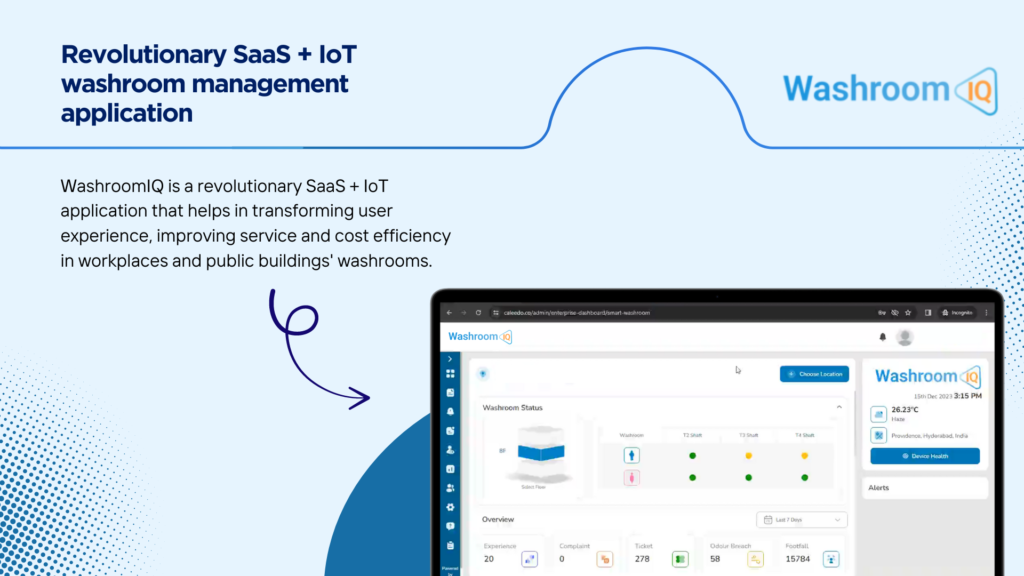
Challenges solved by an IoT-based automated washroom management system – WashroomIQ Occupied spaces within workplaces have been the focus for workplace technology-led digitization to increase efficiency & make them more smart but unoccupied spaces especially washrooms have been neglected to a certain degree. Ensuring a clean and healthy washroom for users while optimizing cost can be challenging for FM and workplace managers. However, with the innovation of automated washroom systems like WashroomIQ, these challenges can be overcome. An automated washroom system should be capable of addressing several challenges faced by FM managers while offering a comprehensive and efficient approach to workplace washroom management. WashroomIQ, our inovative SaaS + IoT applications offers a comprehensive solution to these challenges: 1. Foul Odor: – WashroomIQ utilizes smart deodorizers equipped with sensors to detect and neutralize foul odors in real-time. – By proactively addressing odor issues, WashroomIQ ensures a pleasant and hygienic environment for users, enhancing overall satisfaction. 2. Wastage reduction: – WashroomIQ’s analytics and monitoring capabilities track consumable usage patterns, preventing overstocking and unnecessary wastage. – This optimized inventory management helps organizations minimize monetary losses associated with excess consumable purchases. 3. Optimzing cost of washroom maintenance: – WashroomIQ digitizes and automates upkeep schedules, streamlining maintenance operations and ensuring timely servicing. – By intelligently allocating resources based on data-driven insights, organizations can enhance operational efficiency and reduce costs. 4. Water Conservation and Sustainability: – By aligning with sustainability agendas, WashroomIQ helps organizations reduce their environmental footprint and promote responsible resource management. 5. Enhanced Washroom Experience and Employee Satisfaction: – WashroomIQ focuses on improving the overall washroom experience for users through features like cleanliness monitoring and feedback mechanisms. – By prioritizing user comfort and hygiene, WashroomIQ contributes to higher levels of employee satisfaction and well-being, ultimately boosting productivity and morale within the organization. Conclusion: WashroomIQ addresses multiple challenges faced by organizations in maintaining washroom facilities, ranging from odor control and consumable management to resource allocation and sustainability initiatives. By leveraging smart technology and data-driven insights, WashroomIQ not only enhances operational efficiency but also improves user experience and promotes a healthier and more sustainable workplace environment. Schedule a demo with us today and discover how WashroomIQ can transform your washroom management. Take the first step towards smarter, more efficient facilities management by contacting us now! Subscribe to Our Newsletter Thank you for Signing Up Please correct the marked field(s) below.1,true,6,Contact Email,2 Thank you for Signing Up Please correct the marked field(s) below.1,true,6,Contact Email,2 Facebook Twitter Youtube Medium Twitter Instagram Spotify Occupied spaces within workplaces have been the focus for workplace technology-led digitization to increase efficiency & make them more smart but unoccupied spaces especially washrooms have been neglected to a certain degree. Ensuring a clean and healthy washroom for users while optimizing cost can be challenging for FM and workplace managers. However, with the innovation of automated washroom systems like WashroomIQ, these challenges can be overcome. An automated washroom system should be capable of addressing several challenges faced by FM managers while offering a comprehensive and efficient approach to workplace washroom management. WashroomIQ, our inovative SaaS + IoT applications offers a comprehensive solution to these challenges: 1. Foul Odor: – WashroomIQ utilizes smart deodorizers equipped with sensors to detect and neutralize foul odors in real time. – By proactively addressing odor issues, WashroomIQ ensures a pleasant and hygienic environment for users, enhancing overall satisfaction. 2. Wastage reduction: – WashroomIQ’s analytics and monitoring capabilities track consumable usage patterns, preventing overstocking and unnecessary wastage. – This optimized inventory management helps organizations minimize monetary losses associated with excess consumable purchases. 3. Optimzing cost of washroom maintenance: – WashroomIQ digitizes and automates upkeep schedules, streamlining maintenance operations and ensuring timely servicing. – By intelligently allocating resources based on data-driven insights, organizations can enhance operational efficiency and reduce costs. 4. Water Conservation and Sustainability: – By aligning with sustainability agendas, WashroomIQ helps organizations reduce their environmental footprint and promote responsible resource management. 5. Enhanced Washroom Experience and Employee Satisfaction: – WashroomIQ focuses on improving the overall washroom experience for users through features like cleanliness monitoring and feedback mechanisms. – By prioritizing user comfort and hygiene, WashroomIQ contributes to higher levels of employee satisfaction and well-being, ultimately boosting productivity and morale within the organization. Conclusion: WashroomIQ addresses multiple challenges faced by organizations in maintaining washroom facilities, ranging from odor control and consumable management to resource allocation and sustainability initiatives. By leveraging smart technology and data-driven insights, WashroomIQ not only enhances operational efficiency but also improves user experience and promotes a healthier and more sustainable workplace environment. Schedule a demo with us today and discover how WashroomIQ can transform your washroom management. Take the first step towards smarter, more efficient facilities management by contacting us now! Subscribe to Our Newsletter Thank you for Signing Up Please correct the marked field(s) below.1,true,6,Contact Email,2 Thank you for Signing Up Please correct the marked field(s) below.1,true,6,Contact Email,2 Facebook Twitter Youtube Medium Twitter Instagram Spotify
National Air Quality Agenda 2031 has been announced by MoCCAE
National Air Quality Agenda 2031 has been announced by MoCCAE Original article – https://www.mepmiddleeast.com/news/national-air-quality-agenda-2031-moccae The Ministry of Climate Change and Environment (MoCCAE) has launched the National Air Quality Agenda 2031, approved by the UAE Cabinet in June 2022. The agenda provides a general framework to lead and align federal and local government entities and the private sector concerning monitoring and effectively managing air quality and reducing air pollution to contribute to a healthy and safe environment. The launch took place during the forum MoCCAE organized to mark the International Day of Clean Air for Blue Skies under the theme “The Air We Share”, featuring multiple presentations of the outcomes of local scientific research about particulate matter composition and sources. The event drew the participation of international organisations, including the United Nations, the Global Green Growth Institute, and the Climate and Clean Air Coalition, as reported by the state news agency Wam. Among the federal and local government entities in attendance were the Ministry of Health and Prevention, the Federal Competitiveness and Statistics Centre, the National Centre of Meteorology, the Environment Agency – Abu Dhabi, Dubai Municipality, Sharjah City Municipality, Abu Dhabi Public Health Centre, the Dubai Health Authority, the Environment Protection and Development Authority in Ras Al Khaimah, and Umm Al Quwain Municipality. Khalifa University, American University of Sharjah, United Arab Emirates University, and New York University Abu Dhabi represented academia at the forum. National Air Quality Agenda 2031 Mariam bint Mohammed Almheiri, Minister of Climate Change and the Environment, said: “Air pollution is one of the main issues affecting the wellbeing of mankind and the environment. Estimated to cause seven million premature deaths annually, it contributes to impeding global efforts to combat climate change.” “To mark the International Day of Clean Air for Blue Skies, we hosted a forum that brought together local and international stakeholders to highlight the interconnection between air pollution and public health, promote collective action to tackle the issue and spur discussions to develop practical solutions. “The development of the agenda was made possible through the valuable contributions of various federal and local government stakeholders. The active participation of our institutional partners proves the paramount importance of this endeavour,” she added. The National Air Quality Agenda 2031 The agenda sets out trends, initiatives, and projects that will be launched in the coming few years to address air pollution in four focus areas: outdoor air quality, indoor air quality, ambient odour and ambient noise. To achieve its targets, the National Air Quality Agenda outlines key enablers, including establishing a clear and robust policy and institutional framework, enhancing technical and human resource capacities, promoting scientific and academic research, leveraging advanced technology, and facilitating access to financial resources. AIR The agenda is built upon three pillars. Monitoring refers to the actual measurement of air pollution and related parameters, while mitigation involves a broad range of existing, planned, and required actions that will be taken to reduce levels of and exposure to pollutants. Finally, management relates to measures that will allow for interventions and initiatives to be effectively implemented, tracked, and controlled to reach the overall goal of improved air quality. Subscribe to Our Newsletter Thank you for Signing Up Please correct the marked field(s) below.1,true,6,Contact Email,2 Thank you for Signing Up Please correct the marked field(s) below.1,true,6,Contact Email,2 Facebook Twitter Youtube Medium Twitter Instagram Spotify Original Article – https://www.mepmiddleeast.com/news/national-air-quality-agenda-2031-moccae The Ministry of Climate Change and Environment (MoCCAE) has launched the National Air Quality Agenda 2031, approved by the UAE Cabinet in June 2022. The agenda provides a general framework to lead and align federal and local government entities and the private sector concerning monitoring and effectively managing air quality and reducing air pollution to contribute to a healthy and safe environment. The launch took place during the forum MoCCAE organized to mark the International Day of Clean Air for Blue Skies under the theme “The Air We Share”, featuring multiple presentations of the outcomes of local scientific research about particulate matter composition and sources. The event drew the participation of international organisations, including the United Nations, the Global Green Growth Institute, and the Climate and Clean Air Coalition, as reported by the state news agency Wam. Among the federal and local government entities in attendance were the Ministry of Health and Prevention, the Federal Competitiveness and Statistics Centre, the National Centre of Meteorology, the Environment Agency – Abu Dhabi, Dubai Municipality, Sharjah City Municipality, Abu Dhabi Public Health Centre, the Dubai Health Authority, the Environment Protection and Development Authority in Ras Al Khaimah, and Umm Al Quwain Municipality. Khalifa University, American University of Sharjah, United Arab Emirates University, and New York University Abu Dhabi represented academia at the forum. Mariam bint Mohammed Almheiri, Minister of Climate Change and the Environment said: “Air pollution is one of the main issues affecting the wellbeing of mankind and the environment. Estimated to cause seven million premature deaths annually, it contributes to impeding global efforts to combat climate change.” “To mark the International Day of Clean Air for Blue Skies, we hosted a forum that brought together local and international stakeholders to highlight the interconnection between air pollution and public health, promote collective action to tackle the issue, and spur discussions to develop practical solutions. “The development of the agenda was made possible through the valuable contributions of various federal and local government stakeholders. The active participation of our institutional partners proves the paramount importance of this endeavor,” she added. The National Air Quality Agenda 2031 The agenda sets out trends, initiatives, and projects that will be launched in the coming few years to address air pollution in four focus areas: outdoor air quality, indoor air quality, ambient odor, and ambient noise. To achieve its targets, the National Air Quality Agenda outlines key enablers, including establishing a clear and robust policy and institutional framework, enhancing technical and human resource capacities, promoting
It’s Time for Companies to Monitor Workplace Air Quality
It’s Time for Companies to Monitor Workplace Air Quality This article was written by: Joseph G. Allen Original article – https://hbr.org/2023/11/its-time-for-companies-to-monitor-workplace-air-quality When the Canadian wildfire smoke hit New York City in June, I got a call from a senior executive with a pressing question: was the air inside their company’s building safe for employees to breathe? I could confidently answer yes thanks to the indoor air quality sensor system I’d helped them deploy several months before. According to the real-time data, particle levels were below the health-based limits even as outdoor levels surged to more than 400 ug/m3 — levels that we know is associated with not only headaches and eye irritation but also heart attacks and hospitalizations. A similar thing happened just the other week when a fellow professor at the Harvard School of Public Health pinged me with concerns about air flow and Covid-19 risk in their classroom. Because we’d installed similar air quality sensors, I was able to quickly see and share that the space exceeded the ventilation targets we had set for Covid. We’ve now rolled out similar sensor networks at Harvard Business School and in the Harvard University Health Clinics. The movement toward real-time air quality monitoring is growing. Both Denver’s and Boston’s public school systems have put these types of sensors in classrooms and make the data publicly available, so parents and caregivers can, for the first time ever, evaluate the air their kids are breathing. New York City is considering a similar plan for schools and government buildings. Amazon just rolled out a real-time air quality monitoring network across its entire global commercial office portfolio (Disclosure: I advised on this project, too, and my company performs ongoing analytics.) Organizations that aren’t yet thinking about how to implement real-time “health” monitoring in their buildings should do so soon for a variety of reasons. First, because the proliferation of lower-cost sensors represents both a paradigm and a power shift. The days of a company hiring someone like me, a certified industrial hygienist, to test a building with a $5,000 scientific instrument over the course of a day and then write up a report are waning. Now any employee or customer can collect rudimentary air quality data in real time with a portable, hand-held sensor that costs about $150. People are taking these sensors into their offices, favorite coffee shops, airplanes, and everywhere else and often sharing the results on social media, sometimes publicly shaming owners of venues where the readings are bad. This is a transformational change. Beyond not getting caught off guard, companies that deploy their own air sensor networks will find that they offer timely actionable information in moments of crisis (as in the wildfire and Covid-19 uptick examples). They can also help identify areas of the building where air quality isn’t dangerous but is still below the level at which research confirms there are productivity benefits. And sensors are a way to ensure buildings can be both energy-efficient and protective of employee health. Outlining the benefits Worker health, safety, and presence. Better air in buildings is associated with less sickness and fewer missed workdays. We know that viruses like SARS-CoV-2, influenza, and RSV are transmitted through the air, and “superspreading” events tend to occur indoors where there is poor ventilation and filtration. Some workers cite this as a reason for not wanting to return to the office. But when you monitor air quality, you have objective data confirming that the building is performing the way it should to remain healthy and safe. In the past, humans were the sensor, and companies would only know there was a problem when there were complaints, or, worse, people got sick. Now you can find issues before they become big issues and take corrective action. Worker productivity. I’ve written in HBR several times about the scientifically proven link between better indoor air quality and higher-order cognitive function across domains such as strategic decision-making, how people seek out and utilize information, and how they respond to crises in a work environment. In short, the air your employees breathe impacts how they perform, and the only way to know if you’re in the optimal range is to measure it. Optimizing health and climate goals. Air quality sensors can also be a secret sustainability tool. Buildings account for 40% of global greenhouse gas emissions; in some cities it’s 70%. As wrote in HBR in January, you could save a lot of energy by closing the dampers and limiting how much outdoor air comes in, but that makes for stale, germ-laced indoor air. On the other hand, many buildings are over ventilating certain areas — dumping cooled air into empty conference rooms all day, for example. If you’re already monitoring energy efficiency in your buildings, you should also have sensors monitoring health to find the optimal balance. Understanding the basics Having (hopefully) convinced why air quality monitoring is important, let’s talk about what’s involved. The sensors are small devices that hang on a wall, much like a thermostat, and measure a handful of key indicators of overall air quality in the space. The data feed into the cloud and can be accessed on a dashboard or integrated into existing building management systems. Nearly all the air quality systems on the market, including lower cost ones, measure the same handful of indicators, including: CO2: carbon dioxide is a great proxy for outdoor air ventilation. Humans are the main source of CO2 indoors, so if CO2 is high, it’s a sign that there’s not enough outdoor air coming into the building. The bare-minimum ventilation standard (which doesn’t protect against infectious disease transmission or capture the cognitive function benefits of better air) for an office equates to about 1000 ppm. Experts, including the Centers for Disease Control, recommend setting the CO2 target at 800ppm. PM2.5: One of the main components in outdoor air pollution is is PM2.5, which stands for “particulate matter
Enhancing workplace security and efficiency: The benefits of a digital visitor management system
Enhancing workplace security and efficiency: The benefits of a digital visitor management system In today’s digital age, where an organization’s first impression is of utmost importance, a visitor management system (VMS) plays a crucial role. In this newsletter, we will delve into how a visitor management system (VMS) benefits an organization in digitally orchestrating the visitor entry, exit, meeting location identification, reservation, and coordination with the host and how it, in turn, helps in enhancing workplace security and experience. What is a digital visitor management system? Unlike traditional practices, a digital visitor management system is a digital application to facilitate check-ins & check-outs of workplace visitors, track incoming visitors, streamline visitor registration, and reduce wait time for entry of visitors while connecting them with the host, reserving a meeting room, etc. Types of Digital Visitor Management Systems – which to choose? When choosing between an on-premise and SaaS Visitor Management System, an organization must carefully take into consideration its IT strategy, data security protocols, budget, and long-term goals. However, on-prem VMSs are now getting antiquated due to their limitations in progressive upgrades, high maintenance, and overall cost of ownership, most advanced VMS applications, globally have migrated to cloud-hosted SaaS applications. By having an informed decision on your IT strategy, business, and functional considerations, you can make an effective visitor management product discovery and procurement decision and therefore, choose a product that offers you a 360O benefit in cost, support, process integration, and functionality advantage. On-Premise VMS: Control and Customization The on-premise Visitor Management Solution was the 1st generation VMS and is now largely antiquated. Most organizations have progressively upgraded these applications/systems in recent years. Otherwise, on-premise solutions come with their inherent challenges. They require significant upfront investment in hardware, software, and IT infrastructure. Maintenance and updates also fall on the organization’s IT team, demanding ongoing resources and expertise. Scalability can be limited, making it challenging to adapt to changing business needs and fluctuations in visitor volumes. SaaS VMS: Flexibility and Scalability In contrast, SaaS VMS solutions such as VisitUs from Caleedo offer flexibility, scalability, and seamless & continuous feature upgrades through upgrade release patches. Hosted in the cloud, the system is accessible via web browsers or mobile apps, eliminating the need for on-site hardware and infrastructure. This makes deployment quick and hassle-free, allowing organizations to get up and running with minimal lead time. SaaS VMS providers handle maintenance, updates, and backups, freeing up IT resources and reducing operational overhead. Furthermore, SaaS VMS solutions are inherently scalable, allowing organizations to adjust resources and features according to evolving needs. Whether accommodating seasonal fluctuations in visitor traffic or expanding to multiple locations, SaaS solutions offer the agility and scalability necessary for growth. Benefits of a SaaS-based digital visitor management system Increased operational efficiency and security A SaaS-based visitor management system offers increased operational efficiency and security. It significantly reduces wait times for visitors and saves paper used in logbooks, streamlining the check-in process. A digital Visitor Management System ensures visitor identity validation, and health status checks, maintains digital records for thorough monitoring, and a host of other value-added data analytics which facilitates and supports data-led security strategy evaluation and implementation in workplaces. The ever-evolving needs of employees and visitors have resulted in the visitor management system continuing to innovate by incorporating AI, ML, and facial recognition technologies. Enhancing Visitor and Host Experience The visitor management system enhances visitor and host experience by catering to both spontaneous walk-ins and pre-approved visitors, allowing for custom and tailor-made experiences that match individual needs and preferences. The mobile-first approach of a Visitor Management System and its intuitive interface enhances the visitor experience, streamlining registration and reducing friction throughout the entire check-in process. It also enables the visitor to digitally sign in either by scanning a QR code or by biometrics such as photos or visitor badges. A digital Visitor Management System allows you to seamlessly pre-schedule meetings with your visitors, providing a more organized and personalized experience. By scheduling in advance, hosts can pre-arrange various services such as catering or IT support, ensuring all necessary amenities are in place for a productive and welcoming visit. Integrating with corporate ecosystems Integrating visitor management systems with corporate ecosystems offers numerous benefits, including a seamless experience by integrating with existing workplace IT systems such as MS Outlook calendars, employee databases, and more. By also connecting with digital workspace applications, such as collaboration and productivity tools, the integration enhances productivity and fosters better collaboration among team members, service providers, and workplace administrators. This interconnected approach facilitates seamless operations and creates a super-efficient and real-time connected work environment for employees, administrators, hosts visitors, and service providers alike. Additionally, integrating with enterprise IT systems (for seamless interoperability to scheduling visitor entries/approvals, meeting room reservations, and service request reservations) access controls and CCTV systems, significantly boosts security by ensuring that only authorized individuals can enter the premises. The connection between access control and surveillance systems provides real-time monitoring and verification, safeguarding the workplace and creating a safer environment for both employees and visitors. Data-led business insights Businesses can gain a competitive advantage by leveraging visitor management analytics. These insights enable organizations to continuously improve the visitor experience by providing data-driven feedback on guest interactions and movements within the premises. Moreover, visitor management analytics offer invaluable support to Facilities and Workplace Managers, aiding them in identifying opportunities for improvements in visitor management policies. By analyzing visitor patterns, durations, and preferences, managers can make informed decisions to streamline processes, optimize resource allocation, and enhance overall security measures. This proactive approach not only enhances visitor satisfaction but also fosters a more efficient, organized, and secure workplace environment. In Conclusion To sum it up a digital visitor management system offers various advantages to organizations seeking to improve and enhance their workplace security and service efficiency keeping in mind, streamlining visitor management and associated work processes. By choosing a SaaS-based application such as VisitUs, companies can tailor their visitor management processes to meet specific needs and long-term goals in their workplaces. By embracing the digital transformation of visitor management, organizations
Caleedo partners with FM Future Labs to promote smart workplace solutions in India

Caleedo partners with FM Future Labs to promote smart and healthy workplace solutions in India We are pleased to announce a strategic partnership between Caleedo and FM Future Labs, marking a significant step forward in our commitment to delivering comprehensive solutions in India. With this partnership, FM Future Labs will serve as our partner,offering our complete range of solutions. This collaboration combines Caleedo’s innovative technology and expertise with FM Future Labs’ deep understanding and extensive reach in commercial real estate. Together, we are poised to address the evolving needs of workplaces and the built environment in India, providing cutting-edge solutions to enhance efficiency, occupant well-being, health, and wellness. We look forward to a successful partnership with FM Future Labs and to empowering our customers in India with the best-in-class solutions and support. We look forward to a successful partnership with FM Future Labs and to empowering our clients in India with the best-in-class solutions and support. About Caleedo – Digitizing Possibilities Caleedo is a first-of-its-kind B2B SaaS Work-tech platform for making workplaces & built environments smart and healthy. Caleedo’s enterprise-ready platform offers multiple digital applications for the built environment and workplaces that elevate occupant experience, and collaboration, and improve the health and wellness agenda. These applications encompass indoor air quality monitoring, surface hygiene monitoring, water hygiene monitoring, smart washroom management, visitor management, and workplace services orchestration. With a mobile-first approach and a focus on ESG (Environmental, Social, and Governance) factors, Caleedo is at the forefront of driving change in the way we experience our workplaces. At Caleedo, we believe that by seamlessly integrating technology with business processes, we can deliver unparalleled value not only to businesses but also to the environment, people, investors, and the community at large. Our clientele boasts iconic Fortune 500 companies, global conglomerates, MNCs, leading ITEs & e-commerce enterprises, and commercial real estate and facility management companies in India and the Middle East. About FM Future Labs At FM Future Labs, they provide a comprehensive range of facility management services, such as business advisory and consulting, facility audits, training support, RFP management, digital technology, and automation. Their dedicated team of experts collaborates with organizations to boost operational efficiency, promote sustainability, and streamline processes, ensuring that facilities reach their full potential. Whether seeking strategic guidance or comprehensive audits, their services are tailored to meet unique facility management needs. Conclusion With FM Future Labs as our representative, we combine Caleedo’s innovative technology and expertise with FM Future Labs’ extensive reach in commercial real estate. Together, we are poised to address the evolving needs of Indian enterprises, providing cutting-edge solutions to enhance efficiency, sustainability, and occupant well-being. We look forward to a successful partnership and empowering clients in India with best-in-class solutions and support. Read More
Caleedo partners with Darson Group to promote smart workplace solutions in India

Caleedo partners with Darson Group to promote smart workplace solutions in India We are pleased to announce that Caleedo and Darson Group, have entered into a strategic partnership aimed at promoting Caleedo’s applications for the smart workplaces in India. The partnership includes representation of VisitUs & Meetable through Darson’s security operations and WashroomIQ through its housekeeping operations. This collaboration marks a significant milestone in our commitment to delivering comprehensive solutions for workplace efficiency, experience, and digitization in India. By leveraging Darson’s expertise in security operations and housekeeping services, coupled with Caleedo’s innovative solutions, we aim to deliver value across various industries. About Caleedo- Digitizing Possibilities Caleedo is a first-of-its-kind B2B SaaS Work-tech platform for making workplaces & built environments smart and healthy. Caleedo’s enterprise-ready platform offers multiple digital applications for the built environment and workplaces that elevate occupant experience, and collaboration, and improve the health and wellness agenda. These applications encompass indoor air quality monitoring, surface hygiene monitoring, water hygiene monitoring, smart washroom management, visitor management, and workplace services orchestration. With a mobile-first approach and a focus on ESG (Environmental, Social, and Governance) factors, Caleedo leads the charge in reshaping workplaces and built environments. Our esteemed clientele includes renowned Fortune 500 companies, global conglomerates, MNCs, leading ITEs & e-commerce enterprises, and commercial real estate and facility management firms across India and the Middle East. About Darson Group Darson offers “Total Security and Integrated Facility Management Services” that are fully digitally enabled, cost-effective, and efficient. With their integrated suite of solutions, they provide precisely what your business model requires – from designing solutions to transitioning and operation managing services. Customers are assured of quality, reliability, responsiveness, and remarkable service delivery with enhanced efficiency. Darson’s culture is founded on values that guide them in building a financially sustainable enterprise in the long term. They conduct business based on these values and foster positive relationships with clients, employees, and other business associates. Darson’s vision is to be a Nationally recognized organization and be a market leader in all business segments they operate in, by adding value and providing an investment to all their clients/customers and enhancing business requirements. Conclusion With a shared vision of excellence, this partnership is poised to redefine standards in workplace security, efficiency, and experience; offering tailored solutions to meet the evolving needs of businesses in India. Together, we look forward to driving positive impact and fostering sustainable growth in the region. Read More
Caleedo announces Strategic partnership with Blue Technologies & Investment LLC

Caleedo announces Strategic partnership with Blue Technologies & Investment LLC Caleedo – Digitizing Possibilities – a leader in the Indian proptech, worktech sector is happy to announce its partnership with Blue Tech and Investment LLC, for the Caleedo Express(TM) range of solutions in the Sultanate of Oman. Blue Technologies and Investment LLC (Al Jassar Group) specializes in digital transformation, cloud computing, and cyber security and is a leading player in the territory. Caleedo and Bluetech would work closely to offer enterprise-grade, best-in-class digital applications in the territory that elevate occupant experience and service efficiency in the workplaces. This collaboration also aims to set new standards of digital-first approach to sustainable practices in offices and large corporate establishments in the Sultanate of Oman. Read More
Caleedo announces strategic partnership with Teams International LLC

Caleedo announces strategic partnership with Teams International LLC Caleedo is delighted to announce a strategic partnership with TEAMS International LLC as our Solution Partner for Oman. Together, Caleedo and TEAMS International LLC are teaming up to revolutionize the management of workplaces and built environments through the integration of ESG, sustainability, and smart workplace solutions in Oman.
Indoor Air Quality standards – A must for healthy workplaces in india

Indoor Air Quality standards – A must for healthy workplaces in India Introduction There is an increasing focus and much discussion about the importance of indoor air quality in enclosed areas where people gather together whether it be offices, hospitals, schools or public places such as malls airports etc. The issue of indoor air quality and its impact on health and wellbeing is more pronounced in the offices or workplaces where people work together for hours. Most work places are located in the most polluted cities or areas in India which makes a strong case for close focus (monitoring) and implementation of appropriate governance, reporting and remedial measures. As per University of Chicago’s Energy Policy Institute (EPIC), the region including India, Bangladesh, Nepal, and Pakistan accounts for more than half of the total life years lost globally to pollution. The issue of air quality within major business hubs in India is also varying degrees as indicated in the chart below (Refer – www.aqi.in): CITY Last 24 hrs average AQI Mumbai (Bandra Kurla Complex) 134 Delhi (New Friends Colony) 451 Chennai (Gandhi Nagar) 89 Hyderabad (Central University) 91 Kolkata (Victoria) 302 Table 1: City-wise last 24 hrs average AQI (As on 15th Nov, 2023) What is Indoor Air Quality (IAQ) The air we breath in is the foundation of good health and wellbeing. Healthy air means less intake of airborne contaminants and other harmful gases which positively impacts overall health thereby enhancing cognitive abilities and productivity at an individual level. At the organization level it leads to higher attendance, improved productivity reduced medical insurance expenses and an overall improvement in employee morale and wellbeing. Many countries have defined the minimum standards for IAQ and in a few of them maintain and reporting the prescribed IAQ levels is now made as a mandatory compliance responsibility for the organization. Many more countries are following suit There are key recommendations made by the industry body ASHRAE as well which are available in the public domain. Air quality is listed one among the Nine foundations for healthy buildings, in a study paper by Harvard TH Chan School of Public Health (Reference: https://9foundations.forhealth.org/) The workplace environment is designed for people to be together – whether it be at a cluster of work stations, in a meeting room, an assembly line, in the cafeteria or recreation area and so on. These are enclosed areas therefore carry a very high level of health risk if the indoor air quality doesn’t comply with the prescribed standards. However, notwithstanding this, Indoor Air Quality in workplace has significant bearing on Outdoor Indoor Quality., i.e. ambient environment There are however established containment strategies prescribed by American Society for Heating, Refrigeration and Airconditioning Engineers (ASHRAE) Standard 62.1 and 62.2, Ventilation and acceptable IAQ) and other leading standards organizations, real estate companies have started to adopt in India. The outdoor air quality is a product of various environmental factors which could be beyond the control of the organizations operating workplaces from these areas. However, a comprehensive approach taking into consideration the ambient air quality and its impact on the indoor air is a must in defining the standards for IAQ within the buildings. Also, within the building, a practical approach to providing the best indoor air quality needs to be integrated, considering air quality of each and every area of the workplace and its correlation with the air quality in the other connected areas and design the HVAC systems that can be dynamically managed to provide consistent IAQ across the facility. Primarily, there are 2 causes of Indoor Air Pollution inside a facility: Ambient condition that influences the pollution inside. Particulate matters (PM), CO (Carbon monoxide), and O3 (Ozone) are the primary constituents. Inside pollution that contributes hugely in the overall indoor pollution due to poor ventilation, occupant monitoring, and control. The principal constituents are VOC, CO2 apart from the effect of uncontrolled temperature and humidity inside. While, there are some air pollutant indexations following the outdoor AQI calculation, till now there is hardly any concrete use and evidence of including VOC, CO2 data in Indoor Air quality Index calculation. IAQ Standards – The case for India As per “World Air Quality Report 2022” published by IQAir, India stands at 8th position in global air pollution index. As on 15th Nov 2023, the current PM2.5 concentration in India is 6.1 times above the recommended limit given by the WHO 24 hrs air quality guidelines value. (As on 15th Nov, 2023). Within India the air quality appears to be the worst in the cities where commercial activities are concentrated. Below figure highlights the AQI of major Indian cities: Figure 1: AQI in Major Indian Cities (As on 15th Nov, 2023) There are multiple factors that contribute towards the poor air quality in India. Activities such as burning of fossil fuels, industrial emissions, vehicular emissions, construction and demolition, agricultural activities, open burning of waste and other microbial decaying process add significantly towards the deterioration of air quality. Added to these are inconsistency in public policies on air pollution control measures, inadequacy of enforcing what exists and lack of public awareness and participation towards reduction of emissions and other polluting activities. The persistent poor outdoor air quality brings in focus the need for air quality management. Current studies on indoor air quality are largely West oriented and therefore the standards also are most applicable to those environments Use of toxic products also called Volatile Organic Compounds (VOCs), inadequate ventilation, uneven temperature, and humidity level can cause indoor air pollution, whether you are in an office, school, or at your comfortable home. In India, there are no separate indoor air quality standards or guidelines yet designed. However, some components involved in determining indoor air quality are considered in the National Building Code 2016 (NBC). The Indian Society of Heating, Refrigerating and Air Conditioning Engineers (ISHRAE) has published an Indoor Environmental Quality Standard that identifies thermal comfort, indoor air quality, comfort, and acoustic comfort as four critical elements of IEQ. Each of these elements