
Why Residents Still Smell the STP — And How Intelligent Odour Control Fixes It
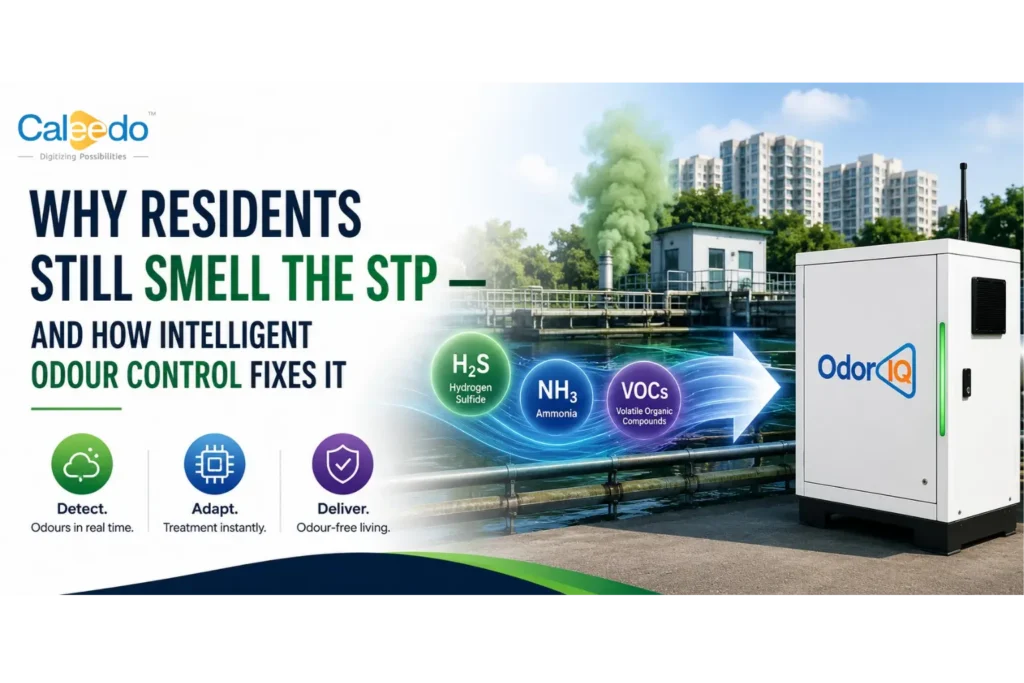
Why Residents Still Smell the STP — And How Intelligent Odour Control Fixes It Ask any facility manager of a township or gated community what they hear most often, and “the STP smells today” will rank near the top. What makes these complaints frustrating is that they keep arriving even when the STP has an in-built odour treatment unit running on schedule. The plant logs say everything is fine. The residents on the 14th floor disagree. The gap between the two is rarely a hardware failure — it’s a control-logic failure. The real culprit: fixed-logic odour control Most conventional STP odour treatment systems run on fixed timers or fixed dosing. They neutralize a steady, assumed odour load. But sewage doesn’t behave that way. Influent volumes spike during morning peaks. Sludge thickening and dewatering release sharp, intermittent bursts of Hydrogen Sulphide (H₂S), Ammonia (NH₃), and Volatile Organic Compounds (VOCs). Anaerobic pockets form whenever aeration falters, even briefly. Against these surges, a fixed-output system simply under-treats — and the untreated gas vents into the air residents breathe. The shift: from fixed logic to closed-loop intelligence This is the problem OdorIQ™ is engineered to solve. Designed for modern STPs, OdorIQ integrates UV-based photonic treatment, embedded control electronics, and IoT-based visibility into a single closed-loop system. Gas sensors continuously monitor H₂S, NH₃, and composite VOC signatures in the exhaust stream. Edge intelligence translates these readings into a real-time odour activity index. UV output is then automatically modulated to match the actual load — neutralizing odour-causing gases before atmospheric discharge, exactly when needed. The result is process-synchronized deodorization rather than blind, continuous treatment. For STPs with variable loads — municipal plants, large campuses, sites with sludge handling — OdorIQ™ Adaptive delivers sensor-driven, dynamic control. For residential STPs and housing societies with predictable operating windows, OdorIQ™ Sync provides time-scheduled, process-aligned treatment. Both are chemical-free, consumable-free, and retrofit-ready. Why this matters for residents The complaint cycle in townships isn’t really about technology gaps — it’s about visibility gaps. With IoT-enabled analytics, alerts, and historical logs, OdorIQ gives operators evidence of exactly when, where, and why odour spiked, and proof of how the system responded. That shift, from reactive defence to observable performance, is what finally puts resident complaints to rest. Download OdorIQ Guide Indoor Air Quality (IAQ) is no longer just a facilities management concern – it has become a strategic priority at the boardroom level, especially in commercial real estate. As organizations focus on employee well-being, ESG goals, and operational efficiency, IAQ is emerging as a critical business factor. Poor indoor air – containing pollutants such as PM2.5, carbon dioxide (CO₂), volatile organic compounds (VOCs), nitrogen dioxide (NO₂), and ozone (O₃) – can negatively impact employee health and cognitive performance. This leads to increased absenteeism, reduced productivity, and higher operational costs. In today’s workplace, where employees spend a significant amount of time indoors, maintaining healthy air quality is directly linked to workforce performance and satisfaction. Research shows that improved IAQ enhances concentration, decision-making, and overall productivity – making it a key driver of business success. Additionally, IAQ is gaining importance in ESG (Environmental, Social, and Governance) frameworks, where organizations are expected to provide safe, healthy, and sustainable environments. Compliance with standards like ASHRAE guidelines, WELL Building Standards (V2) and real-time environmental monitoring has become essential. For Heads of Facilities and EHS leaders, this shift means moving beyond periodic air quality checks to continuous IAQ monitoring. Real-time data helps detect issues early, optimize HVAC performance, and ensure consistent indoor comfort. In commercial real estate, IAQ is also becoming a competitive differentiator. Buildings with advanced air quality monitoring systems attract premium tenants, improve occupancy rates, higher rentals and enhance brand reputation. Caleedo’s Indoor Air Quality Monitoring solutions empower organizations with actionable insights, enabling them to create healthier, smarter, and future-ready workplaces. 👉 Download IAQ Monitoring Guide Disclaimer: This document is intended for informational purposes only and does not constitute professional engineering or regulatory advice.
Smart Washroom Management for Airports & Malls | Caleedo
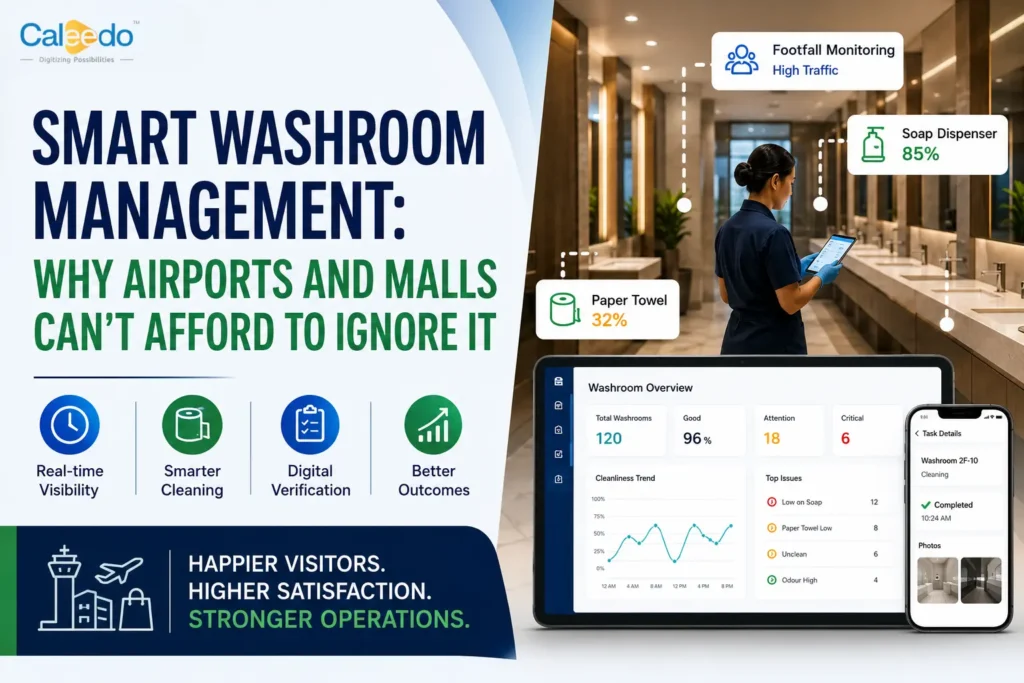
Smart Washroom Management: Why Airports and Malls Can’t Afford to Ignore It Poor washroom experiences silently damage your venue’s reputation. Smart washroom management gives facility teams the real-time visibility to act before visitors notice. In airports and shopping malls, every guest touchpoint matters. Yet one of the most visited spaces – the washroom – is still managed through fixed schedules and paper checklists in most large venues. The result? Missed issues, wasted cleaning rounds, and guest complaints that could have been prevented. What is smart washroom management? Smart washroom management uses IoT sensors, real-time footfall data, and digital task verification to move facility teams from reactive to predictive. Instead of cleaning on a clock, staff are alerted based on actual usage. Consumable levels are monitored automatically. Every service round is logged digitally — no paper, no guesswork. Why it matters for airport and mall operations Research shows that washroom quality is among the top three factors affecting overall venue satisfaction scores. For airport operations heads and mall managers, a poorly maintained washroom doesn’t just frustrate visitors – it directly impacts NPS scores, dwell time, and tenant satisfaction. With smart washroom solutions, operations teams can reduce unnecessary cleaning rounds by up to 30%, cut consumable wastage, and resolve issues before visitors encounter them. The Caleedo advantage Caleedo’s facility management platform integrates smart washroom intelligence alongside your broader building data – giving operations teams a single dashboard for real-time alerts, staff attendance verification, and SLA compliance reporting. No more blind spots in your facility. Ready to eliminate washroom blind spots? Discover how Caleedo helps airport and mall operations teams deliver consistent, data-driven washroom management at scale. Download the full case study Indoor Air Quality (IAQ) is no longer just a facilities management concern – it has become a strategic priority at the boardroom level, especially in commercial real estate. As organizations focus on employee well-being, ESG goals, and operational efficiency, IAQ is emerging as a critical business factor. Poor indoor air – containing pollutants such as PM2.5, carbon dioxide (CO₂), volatile organic compounds (VOCs), nitrogen dioxide (NO₂), and ozone (O₃) – can negatively impact employee health and cognitive performance. This leads to increased absenteeism, reduced productivity, and higher operational costs. In today’s workplace, where employees spend a significant amount of time indoors, maintaining healthy air quality is directly linked to workforce performance and satisfaction. Research shows that improved IAQ enhances concentration, decision-making, and overall productivity – making it a key driver of business success. Additionally, IAQ is gaining importance in ESG (Environmental, Social, and Governance) frameworks, where organizations are expected to provide safe, healthy, and sustainable environments. Compliance with standards like ASHRAE guidelines, WELL Building Standards (V2) and real-time environmental monitoring has become essential. For Heads of Facilities and EHS leaders, this shift means moving beyond periodic air quality checks to continuous IAQ monitoring. Real-time data helps detect issues early, optimize HVAC performance, and ensure consistent indoor comfort. In commercial real estate, IAQ is also becoming a competitive differentiator. Buildings with advanced air quality monitoring systems attract premium tenants, improve occupancy rates, higher rentals and enhance brand reputation. Caleedo’s Indoor Air Quality Monitoring solutions empower organizations with actionable insights, enabling them to create healthier, smarter, and future-ready workplaces. 👉 Download IAQ Monitoring Guide Disclaimer: This document is intended for informational purposes only and does not constitute professional engineering or regulatory advice.
Why Indoor Air Quality (IAQ) is Becoming a Boardroom Issue in Commercial Real Estate
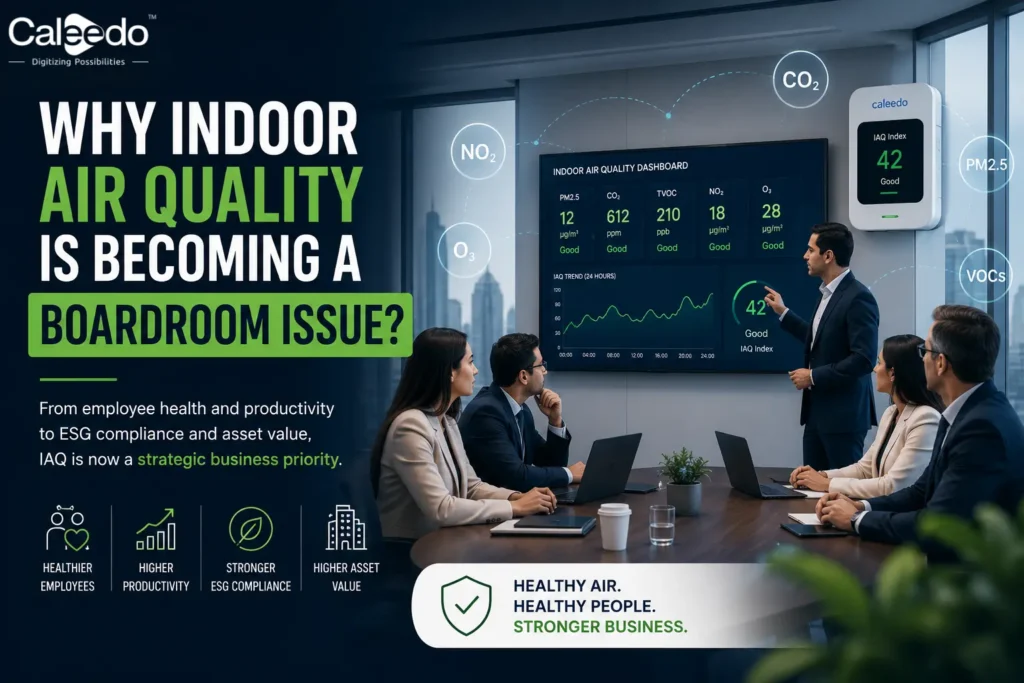
Why Indoor Air Quality is Becoming a Boardroom Issue? Indoor Air Quality (IAQ) is no longer just a facilities management concern – it has become a strategic priority at the boardroom level, especially in commercial real estate. As organizations focus on employee well-being, ESG goals, and operational efficiency, IAQ is emerging as a critical business factor. Poor indoor air – containing pollutants such as PM2.5, carbon dioxide (CO₂), volatile organic compounds (VOCs), nitrogen dioxide (NO₂), and ozone (O₃) – can negatively impact employee health and cognitive performance. This leads to increased absenteeism, reduced productivity, and higher operational costs. In today’s workplace, where employees spend a significant amount of time indoors, maintaining healthy air quality is directly linked to workforce performance and satisfaction. Research shows that improved IAQ enhances concentration, decision-making, and overall productivity – making it a key driver of business success. Additionally, IAQ is gaining importance in ESG (Environmental, Social, and Governance) frameworks, where organizations are expected to provide safe, healthy, and sustainable environments. Compliance with standards like ASHRAE guidelines, WELL Building Standards (V2) and real-time environmental monitoring has become essential. For Heads of Facilities and EHS leaders, this shift means moving beyond periodic air quality checks to continuous IAQ monitoring. Real-time data helps detect issues early, optimize HVAC performance, and ensure consistent indoor comfort. In commercial real estate, IAQ is also becoming a competitive differentiator. Buildings with advanced air quality monitoring systems attract premium tenants, improve occupancy rates, higher rentals and enhance brand reputation. Caleedo’s Indoor Air Quality Monitoring solutions empower organizations with actionable insights, enabling them to create healthier, smarter, and future-ready workplaces. 👉 Download IAQ Monitoring Guide Disclaimer: This document is intended for informational purposes only and does not constitute professional engineering or regulatory advice. Indoor Air Quality (IAQ) is no longer just a facilities management concern – it has become a strategic priority at the boardroom level, especially in commercial real estate. As organizations focus on employee well-being, ESG goals, and operational efficiency, IAQ is emerging as a critical business factor. Poor indoor air – containing pollutants such as PM2.5, carbon dioxide (CO₂), volatile organic compounds (VOCs), nitrogen dioxide (NO₂), and ozone (O₃) – can negatively impact employee health and cognitive performance. This leads to increased absenteeism, reduced productivity, and higher operational costs. In today’s workplace, where employees spend a significant amount of time indoors, maintaining healthy air quality is directly linked to workforce performance and satisfaction. Research shows that improved IAQ enhances concentration, decision-making, and overall productivity – making it a key driver of business success. Additionally, IAQ is gaining importance in ESG (Environmental, Social, and Governance) frameworks, where organizations are expected to provide safe, healthy, and sustainable environments. Compliance with standards like ASHRAE guidelines, WELL Building Standards (V2) and real-time environmental monitoring has become essential. For Heads of Facilities and EHS leaders, this shift means moving beyond periodic air quality checks to continuous IAQ monitoring. Real-time data helps detect issues early, optimize HVAC performance, and ensure consistent indoor comfort. In commercial real estate, IAQ is also becoming a competitive differentiator. Buildings with advanced air quality monitoring systems attract premium tenants, improve occupancy rates, higher rentals and enhance brand reputation. Caleedo’s Indoor Air Quality Monitoring solutions empower organizations with actionable insights, enabling them to create healthier, smarter, and future-ready workplaces. 👉 Download IAQ Monitoring Guide Disclaimer: This document is intended for informational purposes only and does not constitute professional engineering or regulatory advice.
Vikas Saxena Appointed Chairman – Publications at FSAI

Vikas Saxena, CEO of Caleedo, Appointed Chairman – Publications at FSAI Caleedo is proud to announce that Vikas Saxena, CEO of Caleedo, has been appointed as Chairman – Publications (Journal, Buzz, Calendar & Members Directory) by the Fire & Security Association of India (FSAI). This prestigious appointment came into effect on 1st April 2026. This appointment recognizes Vikas Saxena’s continued leadership, industry expertise, and contributions to the fire and security and workplace technology ecosystem. Over the years, he has played a key role in driving innovation, knowledge sharing, and digital transformation across modern workplaces. In his role as Chairman – Publications at FSAI, Vikas Saxena will contribute to shaping the direction and quality of the association’s publications, including its journal, newsletters, industry updates, and member communication platforms. His leadership will support FSAI’s efforts to strengthen collaboration, share industry insights, and promote best practices within the fire and security industry in India. The Fire & Security Association of India (FSAI) is a leading industry body that connects fire and security professionals, organizations, and technology providers across the country. Through its publications and initiatives, FSAI continues to promote knowledge exchange and professional development within the sector. Caleedo congratulates Vikas Saxena on this well-deserved recognition and looks forward to his continued contributions toward advancing the fire and security industry and workplace innovation. 🚀 Exciting News! We are delighted to share that Mr. Vikas Saxena, CEO of Caleedo, has been appointed as Chairman – IoT & Automation at the Fire & Security Association of India (FSAI). With over 27 years of experience in intelligent building management, Fire & security systems, and Automation & Control, Vikas brings unmatched expertise and leadership. Having worked with global organizations like G4S, Honeywell, Johnson Controls, and Ceasefire, he continues to contribute immensely to the safety and workplace automation domain. Beyond his professional journey, Vikas is an active industry contributor, thought leader, philanthropist, and mentor—constantly driving innovation and positive change in the community. 🌟 Please join us in congratulating him on this new role and wishing him success in his journey ahead!
6 New AQI Monitoring Stations Not Yet Linked to Delhi System
6 New Air Quality Monitoring Stations Yet to Be Integrated into Delhi’s AQI System New Delhi: Six newly installed air quality monitoring stations set up by the Delhi Pollution Control Committee are operational but have not yet been integrated into the national AQI network managed by the Central Pollution Control Board. With these additions, the total number of monitoring stations in Delhi has increased to 46. However, the city’s official Air Quality Index (AQI) is still being calculated based on data from the previously active stations. Officials said the new stations are currently collecting data and will be included in the central system after evaluation. Experts noted that the placement of these stations could influence overall AQI readings once officially incorporated. The development comes amid continued concerns over fluctuating pollution levels in the capital, where authorities are working to strengthen real-time monitoring and improve data accuracy for better air quality management and public awareness. Original Article – https://timesofindia.indiatimes.com/city/delhi/6-air-stations-ready-but-kept-on-bench-by-pollution-board/articleshow/128725656.cmcs 🚀 Exciting News! We are delighted to share that Mr. Vikas Saxena, CEO of Caleedo, has been appointed as Chairman – IoT & Automation at the Fire & Security Association of India (FSAI). With over 27 years of experience in intelligent building management, Fire & security systems, and Automation & Control, Vikas brings unmatched expertise and leadership. Having worked with global organizations like G4S, Honeywell, Johnson Controls, and Ceasefire, he continues to contribute immensely to the safety and workplace automation domain. Beyond his professional journey, Vikas is an active industry contributor, thought leader, philanthropist, and mentor—constantly driving innovation and positive change in the community. 🌟 Please join us in congratulating him on this new role and wishing him success in his journey ahead!
Why Parking Management Is No Longer About Cars — But About Human Health, Wellness, and Productivity

Why Parking Management Is No Longer About Cars – But About Human Health, Wellness, and Productivity India’s urban landscape is changing fast—and parking is quietly becoming one of its most critical pressure points. With rapid urbanization, rising vehicle ownership, and dense mixed-use developments, the demand for managed parking facilities has grown from a convenience issue into a matter of urban efficiency, health, and productivity. Growing need for managed parking in India India adds millions of vehicles to its roads every year. Passenger vehicle ownership has crossed 30 million units annually in sales, while two-wheelers and commercial vehicles continue to grow alongside them. This surge is being fueled by multiple sectors: Commercial real estate: IT parks, business districts, SEZs, and corporate campuses housing thousands of daily commuters. Retail & mixed-use developments: Malls, multiplexes, and high-street retail that depend heavily on customer convenience. Healthcare & education: Hospitals and large academic campuses where unmanaged parking directly affects emergency access and daily operations. Residential complexes: High-density apartments where parking demand often exceeds original design capacity. Transit hubs: Airports, metro stations, railway stations, and bus terminals integrating park-and-ride models. Despite this growth, a large percentage of parking spaces in India remain manually managed or entirely unmanaged, leading to inefficiencies that extend well beyond traffic congestion. The hidden cost of manual and unmanaged parking Poorly managed parking has a direct and often underestimated impact on health, wellness, and productivity. Increased stress and anxiety Searching for parking—especially in offices, hospitals, or crowded retail areas—creates frustration and mental fatigue before a person even reaches their destination. Over time, this contributes to commuter stress and burnout. Air quality and health impacts Vehicles circling for parking increase idle time, fuel consumption, and localized emissions. In basements and enclosed parking structures, poor ventilation combined with unmanaged traffic leads to higher concentrations of CO₂, particulate matter, and exhaust fumes—impacting respiratory health. Lost productivity Employees spending 10–20 extra minutes daily looking for parking translates into thousands of lost man-hours annually for large campuses. For visitors and customers, inconvenience reduces dwell time and repeat visits. Safety risks Unstructured parking increases chances of accidents, pedestrian conflicts, poor visibility, and emergency access blockage—particularly critical in hospitals and residential complexes. Operational inefficiency Manual ticketing, cash handling, and human-dependent enforcement are prone to errors, leakages, and disputes. Technology as the mitigation engine Modern Parking Management Systems (PMS) use a combination of IoT, automation, and mobile platforms to convert parking from chaos into a predictable, data-driven service. 1. IoT-enabled sensing and visibility Smart sensors (ultrasonic, magnetic, camera-based) detect real-time occupancy at slot, zone, or floor level. This data feeds centralized dashboards that show exactly where space is available—eliminating guesswork. 2. Automated access and enforcement ANPR (Automatic Number Plate Recognition) enables seamless entry/exit without tickets. Boom barriers and RFID automate access for authorized users. Digital violation detection reduces manual policing and improves compliance. 3. Smart guidance and wayfinding Digital signages and mobile apps guide drivers directly to available slots, reducing circulation time, emissions, and frustration—especially in large basements and multi-level structures. 4. Mobile apps and user experience Apps allow users to: Check availability before arrival Reserve parking slots Navigate to the exact location Make cashless payments Receive reminders and receipts This turns parking into a predictable, user-friendly service rather than a daily gamble. 5. Analytics and integration Parking systems integrate with Building Management Systems (BMS), access control, and ERP platforms. Analytics reveal peak loads, underutilized areas, revenue patterns, and future capacity needs—enabling informed planning instead of reactive expansion. ROI: why parking management pays for itself The return on investment from a smart parking system goes far beyond fee collection. Quantitative ROI Time savings: 30–60% reduction in parking search time. Revenue uplift: Improved compliance, dynamic pricing, and reduced leakage can increase parking revenue by 15–30%. Lower operating costs: Automation reduces manpower, cash handling, and dispute resolution costs. Energy savings: Optimized traffic flow reduces ventilation and lighting runtime in parking areas. Asset optimization: Better utilization delays the need for costly new parking construction. Qualitative ROI Improved occupant experience: Reduced stress and smoother arrivals improve employee morale and customer satisfaction. Health and wellness benefits: Lower emissions, reduced idling, and safer pedestrian movement. Brand and property value: Well-managed parking enhances the perceived quality of commercial and residential assets. Regulatory readiness: Digital logs and access control support safety audits and compliance. Sustainability goals: Reduced emissions and efficient use of existing infrastructure align with ESG objectives. Summary In India’s dense, vehicle-heavy cities, parking is no longer a backend facility – it is a frontline experience that shapes how people perceive offices, homes, hospitals, and retail spaces. Technology-driven parking management systems transform parking from a daily frustration into a strategic asset, delivering measurable economic returns while improving health, wellness, and urban livability. As cities continue to grow vertically and horizontally, smart parking will be as essential as smart buildings—quietly enabling productivity, safety, and sustainability at scale While Indore’s success reflects the impact of sustained governance and citizen participation, the performance of Delhi (ranked 32nd) and several other metro cities underscores the challenges India still faces in addressing urban air pollution.
National Startup Day 2026: Celebrating India’s Innovative Ecosystem and Leadership in Growth

National Startup Day 2026: Celebrating India’s Innovative Ecosystem and Leadership in Growth India marked National Startup Day 2026, celebrating a decade of transformative innovation and the remarkable journey of the Startup India Initiative in shaping the nation’s entrepreneurial ecosystem. This year’s celebrations highlighted the dynamic contributions of visionary founders whose startups are driving scalable impact, job creation, and inclusive growth across sectors such as technology, healthcare, fintech, and sustainability. At the heart of this celebration was Mr. Vikas Saxena, CEO of Caleedo – Digitizing Possibilities, representing leadership from India’s evolving SaaS and workplace tech landscape. With over 25 years of strategic business leadership experience, Vikas Saxena continues to drive Caleedo’s mission of integrating smart workplace solutions and ESG-centric digital innovation, contributing to India’s growing technology ecosystem. National Startup Day underscores the importance of entrepreneurial resilience, actionable innovation, and sustainable scaling – principles that align with Caleedo’s vision to deliver impactful solutions for modern enterprises. As startups across India chart new frontiers of growth, Caleedo remains committed to supporting this vibrant startup ecosystem through meaningful collaborations, customer-centric technology, and leadership that inspires the next wave of digital transformation. 🚀 Exciting News! We are delighted to share that Mr. Vikas Saxena, CEO of Caleedo, has been appointed as Chairman – IoT & Automation at the Fire & Security Association of India (FSAI). With over 27 years of experience in intelligent building management, Fire & security systems, and Automation & Control, Vikas brings unmatched expertise and leadership. Having worked with global organizations like G4S, Honeywell, Johnson Controls, and Ceasefire, he continues to contribute immensely to the safety and workplace automation domain. Beyond his professional journey, Vikas is an active industry contributor, thought leader, philanthropist, and mentor—constantly driving innovation and positive change in the community. 🌟 Please join us in congratulating him on this new role and wishing him success in his journey ahead!
Younger Employees May Quit Over Poor Indoor Air Quality | Report
Proud Moment: Our CEO Vikas Saxena Named FSAI Chairman for IoT & Automation 🚀 Exciting News! We are delighted to share that Mr. Vikas Saxena, CEO of Caleedo, has been appointed as Chairman – IoT & Automation at the Fire & Security Association of India (FSAI). With over 27 years of experience in intelligent building management, Fire & security systems, and Automation & Control, Vikas brings unmatched expertise and leadership. Having worked with global organizations like G4S, Honeywell, Johnson Controls, and Ceasefire, he continues to contribute immensely to the safety and workplace automation domain. Beyond his professional journey, Vikas is an active industry contributor, thought leader, philanthropist, and mentor—constantly driving innovation and positive change in the community. 🌟 Please join us in congratulating him on this new role and wishing him success in his journey ahead! 🚀 Exciting News! We are delighted to share that Mr. Vikas Saxena, CEO of Caleedo, has been appointed as Chairman – IoT & Automation at the Fire & Security Association of India (FSAI). With over 27 years of experience in intelligent building management, Fire & security systems, and Automation & Control, Vikas brings unmatched expertise and leadership. Having worked with global organizations like G4S, Honeywell, Johnson Controls, and Ceasefire, he continues to contribute immensely to the safety and workplace automation domain. Beyond his professional journey, Vikas is an active industry contributor, thought leader, philanthropist, and mentor—constantly driving innovation and positive change in the community. 🌟 Please join us in congratulating him on this new role and wishing him success in his journey ahead! 🚀 Exciting News! We are delighted to share that Mr. Vikas Saxena, CEO of Caleedo, has been appointed as Chairman – IoT & Automation at the Fire & Security Association of India (FSAI). With over 27 years of experience in intelligent building management, Fire & security systems, and Automation & Control, Vikas brings unmatched expertise and leadership. Having worked with global organizations like G4S, Honeywell, Johnson Controls, and Ceasefire, he continues to contribute immensely to the safety and workplace automation domain. Beyond his professional journey, Vikas is an active industry contributor, thought leader, philanthropist, and mentor—constantly driving innovation and positive change in the community. 🌟 Please join us in congratulating him on this new role and wishing him success in his journey ahead!
Indore Tops Swach Vayu 2025 | What India’s air quality Shift Means

Indore Leads Swachh Vayu Sarvekshan 2025, Delhi Slips to 32nd: What It Means for India’s Air Quality Mission Indore, India’s cleanest city, has added another feather to its cap by securing the top position in Swachh Vayu Sarvekshan (Clean Air Survey) 2025 for cities with populations over 10 lakh. The rankings, announced under the National Clean Air Programme (NCAP), recognize cities for their efforts in implementing air pollution mitigation measures on the ground. While Indore’s success reflects the impact of sustained governance and citizen participation, the performance of Delhi (ranked 32nd) and several other metro cities underscores the challenges India still faces in addressing urban air pollution. About Swachh Vayu Sarvekshan The Swachh Vayu Sarvekshan (SVS) is a Government of India initiative that evaluates 130 cities across three population categories: Category 1: Cities with population above 10 lakh (47 cities) Category 2: Cities with population between 3–10 lakh (43 cities) Category 3: Cities with population under 3 lakh (40 cities) Unlike conventional pollution indices, SVS emphasizes implementation of clean air action plans, assessing measures such as: Biomass and municipal waste management Road dust and construction dust control Reduction of vehicular and industrial emissions Improvements in PM10 levels Public awareness initiatives Highlights from the 2025 Rankings Top Performers: Category 1 (Over 10 lakh): Indore, Jabalpur, Agra & Surat Category 2 (3–10 lakh): Amravati, Jhansi & Moradabad, Alwar Category 3 (Under 3 lakh): Dewas, Parwanoo, Angul Metro City Performance: Delhi, Mumbai, Kolkata, and Bengaluru continue to report PM10 levels of 92 µg/m³ or higher—well above the national safe limit of 60 µg/m³ under the National Ambient Air Quality Standards (NAAQS). Chennai stands out as the only major metro within safe limits, recording 58 µg/m³. Mumbai achieved the highest progress, with a 44% reduction in PM10 since 2017–18. National Progress Under NCAP The survey shows that India is making gradual progress in its clean air mission: 103 cities have recorded declining PM10 levels. 64 cities achieved a 20% reduction in PM10 (2017–18 to 2024–25). 25 cities reached a 40% reduction. This indicates that while challenges persist in large metros, smaller and mid-sized cities are successfully leveraging NCAP to improve air quality. Why These Rankings Matter Air pollution remains one of the biggest urban health risks in India. Elevated levels of PM10 and PM2.5 contribute to respiratory illnesses, cardiovascular diseases, and reduced productivity. For businesses and workplaces, this translates into increased absenteeism, higher healthcare costs, and reduced employee well-being. The Swachh Vayu Sarvekshan 2025 reinforces that: Action drives results – Cities like Indore and Amravati show how consistent interventions deliver measurable improvements. Metros face unique challenges – Rapid urbanization, vehicular load, and construction activity make sustained action critical in Delhi, Mumbai, and Bengaluru. Clean air is central to sustainability – Cleaner cities support healthier citizens, more resilient workplaces, and stronger economies. Moving Towards Cleaner, Healthier Workplaces At Caleedo, we believe that cleaner air and sustainable workplaces go hand in hand. The lessons from Swachh Vayu Sarvekshan 2025 extend beyond city planning—they underline the importance of continuous monitoring, technology-driven solutions, and behavioral change in achieving long-term air quality goals. As businesses and institutions adapt to sustainability goals, integrating air quality monitoring, smart facility management, and awareness initiatives becomes essential—not just to comply with regulations, but to create workplaces that are healthier, more productive, and future-ready. Conclusion The results of Swachh Vayu Sarvekshan 2025 are both encouraging and cautionary. While Indore sets a benchmark for clean air leadership, the struggles of Delhi and other metros highlight the urgent need for collaborative, multi-sectoral action. For India to achieve its clean air vision, cities, businesses, and citizens must work together to ensure that air quality improvements translate into healthier lives and sustainable urban growth.
Vikas Saxena, CEO of Caleedo, Appointed FSAI Chairman – IoT & Automation

Proud Moment: Our CEO Vikas Saxena Named FSAI Chairman for IoT & Automation 🚀 Exciting News! We are delighted to share that Mr. Vikas Saxena, CEO of Caleedo, has been appointed as Chairman – IoT & Automation at the Fire & Security Association of India (FSAI). With over 27 years of experience in intelligent building management, Fire & security systems, and Automation & Control, Vikas brings unmatched expertise and leadership. Having worked with global organizations like G4S, Honeywell, Johnson Controls, and Ceasefire, he continues to contribute immensely to the safety and workplace automation domain. Beyond his professional journey, Vikas is an active industry contributor, thought leader, philanthropist, and mentor—constantly driving innovation and positive change in the community. 🌟 Please join us in congratulating him on this new role and wishing him success in his journey ahead! 🚀 Exciting News! We are delighted to share that Mr. Vikas Saxena, CEO of Caleedo, has been appointed as Chairman – IoT & Automation at the Fire & Security Association of India (FSAI). With over 27 years of experience in intelligent building management, Fire & security systems, and Automation & Control, Vikas brings unmatched expertise and leadership. Having worked with global organizations like G4S, Honeywell, Johnson Controls, and Ceasefire, he continues to contribute immensely to the safety and workplace automation domain. Beyond his professional journey, Vikas is an active industry contributor, thought leader, philanthropist, and mentor—constantly driving innovation and positive change in the community. 🌟 Please join us in congratulating him on this new role and wishing him success in his journey ahead! 🚀 Exciting News! We are delighted to share that Mr. Vikas Saxena, CEO of Caleedo, has been appointed as Chairman – IoT & Automation at the Fire & Security Association of India (FSAI). With over 27 years of experience in intelligent building management, Fire & security systems, and Automation & Control, Vikas brings unmatched expertise and leadership. Having worked with global organizations like G4S, Honeywell, Johnson Controls, and Ceasefire, he continues to contribute immensely to the safety and workplace automation domain. Beyond his professional journey, Vikas is an active industry contributor, thought leader, philanthropist, and mentor—constantly driving innovation and positive change in the community. 🌟 Please join us in congratulating him on this new role and wishing him success in his journey ahead!